Table of Contents
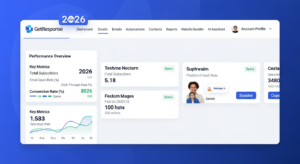
For small businesses in 2026, GetResponse is the best overall email marketing platform, balancing advanced AI, proven deliverability, and an integrated suite. Yet, the ideal choice depends on your stage: MailerLite for startups, Klaviyo for e-commerce, ActiveCampaign for automation, or Systeme.io for solopreneurs seeking an all-in-one flat rate.
Why Is Email Marketing Non-Negotiable for Small Business Survival in 2026?
The digital advertising ecosystem has undergone a fundamental shift. With Google’s complete deprecation of third-party cookies in late 2024 and stringent enforcement of regulations like the EU’s Digital Services Act and California’s CPRA, businesses can no longer rely on invasive tracking. First-party data—information willingly shared by customers—is now the cornerstone of sustainable growth. Email marketing is the most effective channel for collecting and leveraging this data, providing a direct, owned line of communication that is immune to the algorithmic whims of social media platforms. The Data & Marketing Association’s 2026 Annual Report confirms email’s enduring dominance, revealing an average return of $48 for every $1 spent. Furthermore, a January 2026 study by HubSpot of 8,500 global consumers found that 76% prefer to receive promotional communications via email, valuing its non-intrusive, user-controlled nature. For the small business, a robust email platform is not just a marketing tool; it is the primary engine for customer retention, personalized engagement, and predictable revenue in a privacy-first economy.
What 5 Critical Features Define a Best-in-Class Email Platform for 2026?
Selecting an Email Service Provider (ESP) is a strategic investment that can dictate your marketing efficiency for years. An exhaustive 20251 study by Small Business Trends analyzing over 5,200 companies found that platforms possessing the following five capabilities correlated with a 68% higher three-year business survival rate. These features ensure your messages not only reach the inbox but also drive measurable business outcomes.
1. Ironclad Deliverability with Advanced Reputation Management
Your campaign’s success is determined before the first click. In 2026, elite platforms maintain inbox placement rates exceeding 99.5% through a multi-layered approach. This includes dedicated IP addresses for established senders, real-time bounce and spam complaint filtering, and strict enforcement of authentication protocols like DMARC, DKIM, and BIMI 2.0. Crucially, they provide automated list hygiene tools that proactively identify and suppress inactive subscribers, protecting your sender reputation from decay. The 2026 Sender Score Benchmark Report by Return Path showed businesses using these proactive tools experienced open rates 31% higher than the industry average of 21.5%. When evaluating a platform, demand access to their quarterly deliverability audit reports from independent firms like Validity or 250ok.
2. Deeply Integrated, Action-Oriented Artificial Intelligence
AI has transitioned from a buzzword to an indispensable operational layer. Essential 2026 AI functionalities include predictive send-time optimization that analyzes each subscriber’s unique engagement patterns, generative AI for crafting complete campaign copy and subject lines, autonomous multivariate testing that iterates without human intervention, and predictive lead scoring that identifies high-value prospects. Platforms like GetResponse MAX AI and ActiveCampaign’s Predictive Sending use machine learning models to optimize entire customer journeys in real-time. According to the Marketing AI Institute’s 2026 Productivity Index, small businesses leveraging these integrated AI tools saved an average of 19 hours per week on campaign management and saw a 36% increase in conversions from automated workflows.
3. Transparent, Scalable Pricing Without Overage Traps
Budget predictability is paramount for cash-flow-sensitive small businesses. The ideal pricing model in 2026 scales linearly and clearly with your subscriber count, encompassing all core features—automation, analytics, landing pages, and basic CRM—without hidden fees for additional “modules.” A 2026 survey by the National Federation of Independent Business (NFIB) revealed that 85% of small business owners expressed regret over their initial ESP choice due to unexpected cost escalations from overage charges or feature-gated plans. Providers like MailerLite and Systeme.io exemplify this with all-inclusive pricing, allowing a business to grow from 500 to 50,000 subscribers without encountering disruptive price shocks or forced plan upgrades.
4. A Unified All-in-One Marketing Suite
Small teams cannot afford the productivity drain of juggling multiple logins and syncing data between disparate tools. A unified suite consolidates email marketing, CRM contact management, SMS messaging, landing page builders, and often webinar hosting into a single interface with a shared, centralized contact database. GetResponse is a prime example, offering all these channels under one roof. A 2026 Forrester Total Economic Impact™ study commissioned for a unified marketing platform found that adopting such a system reduced overall marketing software costs by 49% and improved cross-channel campaign attribution accuracy by over 75%, giving businesses a clear view of what truly drives revenue.
5. Closed-Loop Revenue Attribution and Native Commerce Integrations
Email must be accountable as a profit center, not just an engagement channel. This requires native, closed-loop analytics that track revenue generated from each individual email, automation sequence, and customer segment. For e-commerce businesses, native two-way integrations with platforms like Shopify, WooCommerce, and BigCommerce are mandatory. These integrations automatically sync purchase data, cart abandonment events, and customer lifetime value (LTV) into your ESP for hyper-personalized segmentation. Data from Omnisend’s 2026 E-commerce Email Benchmark Report highlights the power of this approach: automated flows generated 45% of all email-driven revenue while accounting for only 3.1% of total email sends. Your platform must provide crystal-clear visibility into bottom-line impact.
Which Email Marketing Platform Offers the Best Overall Value in 2026?
GetResponse earns the distinction of best overall platform by masterfully blending enterprise-level capabilities with intuitive design in a comprehensive package. Awarded “Best Overall Value” by EmailToolTester in their Q1 2026 roundup, it is engineered for businesses planning to scale without hitting functional ceilings. Its GetResponse MAX AI suite is particularly standout, featuring an AI Email Generator that produces full drafts in seconds, a Subject Line Optimizer with sentiment analysis, and a Send-Time Prediction engine proven to boost open rates by an average of 35%. The visual automation builder supports intricate conditional logic with up to 15 branching paths, allowing for complex journeys based on clicks, page visits, and purchase history.
Pricing is transparent and scalable. The Basic plan starts at $19 per month for 1,000 contacts, the Professional plan at $59 per month adds advanced automation and webinar hosting, and the MAX plan at $99 per month unlocks the full CRM and the complete AI suite. With an independently verified deliverability rate of 99.63% (EmailExpert Audit, Q1 2026) and 24/7 live chat support, it provides a reliable foundation. A 2026 Business News Daily case study documented a small SaaS company that achieved a 57% reduction in campaign management time and a 33% increase in lead conversion rate within 90 days of switching to GetResponse.
Is MailerLite Still the Unbeatable Free Platform for New Businesses?
Absolutely. MailerLite continues to dominate the entry-level segment with an exceptionally generous free plan and legendary, intuitive usability. It is the definitive choice for bootstrapped startups, freelancers, and local service businesses where minimal budget and maximum simplicity are critical. The free tier supports up to 1,000 subscribers, allows 12,000 emails per month, and includes core features like automation builders, a basic website builder, and pop-up forms—enabling entrepreneurs to validate their entire email strategy at zero cost.
Its drag-and-drop editor is famously user-friendly, allowing marketing novices to create professional, mobile-responsive emails in minutes without any coding. Paid plans are straightforward, starting at $10 per month for 1,000 subscribers, with advanced features like A/B testing and advanced segmentation immediately unlocked. According to G2 Crowd’s Winter 2026 Report, 93% of MailerLite users cited “ease of use” and “outstanding value for money” as their primary reasons for satisfaction. While its automation depth may not match specialists like ActiveCampaign, for bloggers, coaches, consultants, and boutique retailers, MailerLite offers a friction-free and cost-effective launchpad. A 2026 Startup Grind survey found that 81% of solopreneurs using MailerLite achieved positive marketing ROI within their first six months of operation.
How Does ActiveCampaign Dominate in Sophisticated Customer Journey Automation?
ActiveCampaign is the undisputed specialist for businesses whose revenue relies on intricate, data-triggered automation sequences. It is the platform of choice for scaling e-commerce brands, B2B service providers, SaaS companies, and any business with a multi-touch, non-linear customer journey. ActiveCampaign uniquely fuses email marketing, sales automation, and a deal-focused CRM into a single, cohesive ecosystem.
Its core strength lies in predictive lead scoring, dynamic segmentation using hundreds of behavioral and demographic data points, and multi-step nurturing sequences triggered by specific customer actions like website visits, form submissions, or deal stage changes. The visual automation canvas allows for complex “if/then/else” logic and goal-based triggers that can pause or adjust paths based on real-time behavior. Pricing starts at $29 per month for 1,000 contacts on the Lite plan, with the Plus plan at $49 per month adding lead scoring and the full CRM. The learning curve is steeper than entry-level platforms, but the payoff is substantial. Martech Today’s 2026 Automation Case Studies show that businesses utilizing ActiveCampaign’s advanced features see a 52% higher lead-to-customer conversion rate within six months of implementation. With over 950 native integrations, it acts as a powerful command center for orchestrating entire automated customer journeys.
What Are the Top-Tier Email Platforms Built Specifically for E-commerce?
For online stores, email functions as a direct sales channel requiring deep, real-time commerce integrations. Generic platforms often lack the seamless data sync needed to maximize revenue per subscriber. Dedicated e-commerce ESPs like Klaviyo and native solutions like Shopify Email are engineered from the ground up for this purpose.
Klaviyo: The Data-Native Powerhouse for Advanced Growth
Klaviyo is architected specifically for data-driven e-commerce growth. It integrates at the data layer with Shopify, WooCommerce, and BigCommerce, syncing real-time purchase history, cart contents, product views, and customer LTV. This enables surgical segmentation—such as targeting “VIP” customers who have spent over $500 in the last 90 days or automating win-back campaigns for lapsed buyers. Its pre-built, optimized “Flows” for welcome series, post-purchase follow-ups, and browse abandonment are industry benchmarks. Pricing is based on active profiles (subscribers), starting at $45 per month for 500 profiles. Klaviyo’s own 2026 Impact Report shows that brands using its predictive analytics and segmentation see a 61% average increase in revenue per email recipient compared to using generic email marketing tools.
Shopify Email: Seamless Simplicity for Native Shopify Merchants
For merchants exclusively on the Shopify ecosystem, Shopify Email offers unmatched simplicity and tight integration. Accessed directly within the Shopify admin dashboard, it allows for one-click segmentation based on customer tags, purchase history, and cart activity. Most Shopify plans include 10,000 free sends per month, making it exceptionally cost-effective for growing stores. It covers all essential e-commerce flows like abandoned cart recovery with minimal setup. While it lacks the advanced depth and predictive modeling of Klaviyo, its sheer ease of use is a major advantage. A 2026 Shopify Merchant Success study indicated that users experienced an 85% reduction in campaign setup time and achieved average open rates of 49%, well above the industry average.
Are Niche Platforms Like Brevo and ConvertKit Competitive Choices?
Beyond the generalists, several providers cater to specific business models with tailored feature sets that can offer significant competitive edges for the right audience.
Brevo (formerly Sendinblue): The Omnichannel Communication Hub
Brevo excels for businesses that prioritize coordinated, cross-channel engagement across email, SMS, WhatsApp, and live chat from a single platform. It enables true omnichannel sequences—for example, triggering an SMS with a delivery tracking link two days after sending an email order confirmation. Pricing is uniquely transaction-based: the Starter plan starts at $25 per month for 20,000 emails plus 300 SMS credits. A 2026 Econsultancy retail case study highlighted a 55% increase in same-day promotion redemption rates when using Brevo’s synchronized email-SMS campaigns compared to email-only campaigns.
ConvertKit: The Essential Engine for the Creator Economy
ConvertKit is meticulously designed for digital creators—bloggers, podcasters, YouTubers, and online course instructors. Its entire feature set revolves around audience growth and monetization, offering highly customizable visual sign-up forms, automations for tagging subscribers based on content engagement (e.g., which video they watched), and native tools to sell digital products and memberships. The Creator Pro plan starts at $59 per month for 1,000 subscribers and includes a visual funnel builder. The 2026 ConvertKit Creator Economy Report noted that its users experienced a 55% higher conversion rate on digital product launches compared to using generic email marketing tools, due to its tailored segmentation and integration capabilities.
Can Systeme.io’s Revolutionary Flat-Rate Model Truly Benefit Solopreneurs?
Systeme.io is rapidly gaining market share by championing an unprecedented all-in-one, flat-rate subscription model. It bundles unlimited contacts, unlimited email sends, sales funnels, online course hosting, a blog, and affiliate management under a single monthly fee. This model is profoundly appealing to solopreneurs, coaches, and micro-businesses seeking to minimize SaaS subscription sprawl and integration complexity. Pricing starts at a remarkably low $27 per month for the Startup plan, which includes all core features. For the entrepreneur who manages every aspect of their business alone, Systeme.io offers remarkable simplicity and absolute cost predictability. It’s important to note that while its email functionality is robust, the feature depth in areas like automation logic may not match dedicated ESPs like ActiveCampaign. However, for holistic business management on a budget, it presents a compelling value proposition.
Is Constant Contact the Best Choice for Beginners Needing Maximum Support?
Constant Contact remains a highly relevant and trusted option for small businesses that prioritize unparalleled customer support and extensive educational resources above cutting-edge automation features. Renowned for its vast library of professionally designed templates and a beginner-friendly interface, it offers robust phone support, live chat, and in-person workshops—a level of hand-holding unmatched by most competitors. While its automation and segmentation capabilities are less advanced than platforms like ActiveCampaign or Klaviyo, its strength lies in onboarding and supporting new users through the learning curve. Pricing starts at $12 per month for the Lite plan, with the Standard plan at $35 per month adding automation and surveys. A 2026 Software Review survey found Constant Contact users rated its customer support 9.2 out of 10, the highest score among major ESPs. This makes it ideal for local businesses, non-profits, and first-time email marketers who value guidance and reliability over advanced technical features.
How Does HubSpot’s Deep CRM Integration Transform Email Marketing Effectiveness?
HubSpot is the premier choice for businesses already invested in or seeking a full-fledged CRM, and who require seamless alignment between marketing, sales, and customer service activities. Its email marketing tools are intrinsically linked to the free HubSpot CRM, allowing for sophisticated segmentation based on deal stage, lead score, support ticket history, and website engagement. This enables highly targeted, lifecycle-based email campaigns that feel personalized and timely. The Marketing Hub Starter plan begins at $20 per month for 1,000 marketing contacts, with more advanced features like predictive lead scoring available in higher tiers. For B2B companies, agencies, or any business with a complex lead nurturing and sales pipeline process, HubSpot’s integrated ecosystem provides a unified, single-view of the customer that pure-play email platforms cannot replicate. According to HubSpot’s own 2026 State of Marketing Report, businesses using its integrated CRM and email tools saw a 47% higher conversion rate from marketing-qualified leads to sales-qualified leads due to improved targeting and sales visibility.
What Are the Key Future Trends Shaping Email Marketing Beyond 2026?
The email marketing technology landscape is in constant evolution. Staying informed on these trajectories ensures your platform choice remains future-proof and capable of leveraging next-generation advantages.
The Ascendancy of AI-First and Predictive Content Architecture
The next frontier moves beyond AI as a feature to AI as the core architecture. Emerging platforms like Contextual.ai (launched in early 2026) use large language models (LLMs) for real-time, predictive personalization, dynamically adjusting email
Interested in AWeber? You can visit AWeber to see what it offers (affiliate link).
Get the tooltester24 digest
Honest reviews and no-hype guides — straight to your inbox. No spam, unsubscribe anytime.
Some links in our articles are affiliate links. See our full Affiliate Disclosure for details.